All episodes
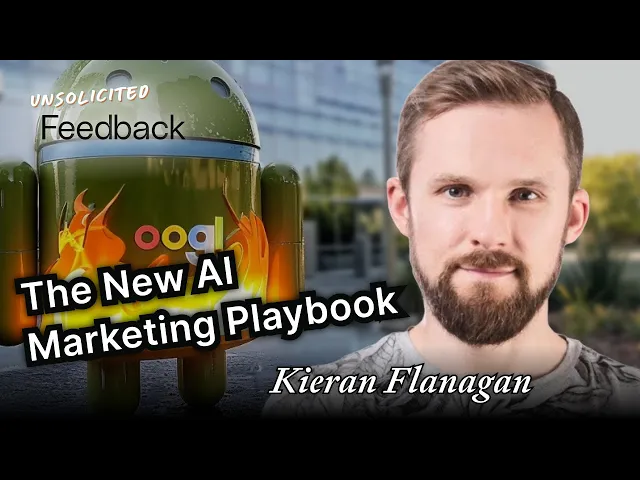
The New AI Marketing Playbook Amid Google's Stumbles w/ Kieran Flanagan
Hosts:
Brian Balfour & Fareed Mosavat
Topics:
Spicy Feedback for Google, Marketing Playbook, AI, PLG, and much more!
Listen on
Spotify | Apple | Pandora | Amazon Music | TuneIn
Defining The AI Marketing Playbook Amid Google's Stumbles w/ Kieran Flanagan
Defining The AI Marketing Playbook Amid Google's Stumbles
This week on Unsolicited Feedback, Brian Balfour & Fareed Mosavat welcomed Kieran Flanagan, and within 30 seconds of taping, Kieran dropped a 💣 on us! He’s leaving his role as CMO of Zapier and rejoining HubSpot to lead initiatives at the intersection of marketing and AI!
Kieran is driven by the opportunity to define the future of marketing in an AI-driven world, and that naturally became our first topic.
🚀 Challenging Google's Dominance in the Age of AI
As Kieran prepares to dive back into HubSpot, Brian mentions that a lot of HubSpot’s success has been accelerated by its ability to conquer Google. So, naturally, we questioned what lies ahead for this behemoth amidst the rise of AI and what the implications of Google’s latest SEO decisions are, given the broad dependency of marketing strategies on Google's search capabilities.
Fareed optimistically suggests that Google will adapt and continue to thrive. However, Kieran presents a compelling counterargument, starkly stating, "Google will not be fine." 🔥🔥🔥
Google's Vulnerability in the AI Era
Would you ever purposefully choose another search engine over Google? Likely not. But would you use another AI platform? Absolutely. Herein lies the problem for Google. Kieran argues that in the world of AI, there is no clear leader, with platforms like Perplexity and ChatGPT showing capabilities that compete directly with Google's Gemini. This new competitive environment challenges the long-assumed superiority of Google and heralds a seismic shift in digital search dynamics.
📉 The Decline of Traditional Search: A New Reality
As AI reshapes how users interact with digital content, traditional search engines face a pivotal challenge. Kieran pointed out a significant shift in user behavior; the percentage of Google searches that did not result in a click-through has risen from 40% in 2019 to 80% today. This change underscores a growing preference for immediate answers provided by AI, reducing the reliance on search engine result pages.
Accelerating the Shift to Closed Gardens
In response to this evolving user behavior, Google has attempted to retain users on its platform by providing summarized content directly in search results. This strategy, while aligning with user preferences for quick information, encourages organizations to guard their content more closely, leading to the creation of "closed gardens" because companies are not incentivized to publish content broadly.
But, if we can’t rely on Search and SEO, how should we market our products?
🤖 Unveiling the AI Marketing Playbook
Kieran Flanagan builds a "AI Marketing Playbook," a fascinating framework for navigating the new realities of an AI-driven marketing world. Each pillar of the playbook not only represents a shift in tools and technologies but also a philosophical reshaping of marketing practices. We imagine we’ll continue building and refining this playbook over the next 6-9 months.
Personalization at Scale: Crafting Unique Consumer Journeys Gone are the days of casting wide nets with broad messages. AI allows for hyper-personalization, transforming generic outreach into highly targeted interactions that speak directly to the individual’s needs and behaviors. For example, an AI system might analyze a user's browsing history and past purchases to offer customized product recommendations in real-time, significantly boosting conversion rates. This level of personalization is akin to having a personal shopper for each customer, a service that was unimaginable at scale before AI but will eventually become table-stakes.
Redefining Product-Led Growth: Automation Meets Intuition In this new era, PLG isn't just about leading with the product; it's about letting the product lead the customer journey through automated onboarding and adaptive demo experiences. Kieran outlines how AI can detect and adapt to user behaviors, making real-time adjustments that enhance user engagement without human intervention. This approach not only scales efficiently but also deepens user engagement by consistently delivering value. The big question is: How will sales teams adjust to losing their ability to sell softballs every month and shifting their energy to only the top-tier leads in size and complexity?
Multimodal Marketing Strategies: Beyond Text Kieran encourages marketers to embrace a multimodal approach, which involves creating content that spans across text, video, and audio. He emphasizes the strategic importance of platforms like YouTube, where marketers can gain a competitive edge and higher defensibility. He says Video is harder to nail than Text, and Audio is more difficult than Video, but both are sure to get more efficient as AI continues to build. 💡🤩 Pro tip: Get smart on YouTube as it demands high-quality content that stands out in a crowded space and is far more defensible today than text-based marketing.
Embracing Creators: Human Creativity Amplified by AI In a world dominated by AI, the human touch becomes a scarce and valuable commodity. Kieran urges brands to collaborate with human creators, using AI as a force multiplier to enhance their creative capabilities. By automating the mundane, creators can focus on innovation and storytelling, driving brand engagement through authenticity and creativity that resonates on a human level.
🔮 Looking Ahead: A Renaissance in Marketing Craft
Kieran articulates a vision for the future where AI's role in marketing mirrors a shift from manual labor to intellectual and creative expression. He notes a profound transition from today's norm, where marketers spend "95% pushing buttons and 5% on craft," to an ideal state where those figures are reversed. This shift is not without its challenges, as it demands a renaissance in skills and mindset from marketers.
Kieran draws inspiration from marketing's golden age in the 1920s—a time devoid of tools where marketers focused purely on craft. He sees a parallel today, as AI liberates marketers from the drudgery of tactical execution, allowing them to return to the roots of their profession: creativity, strategy, and human connection.
Key Takeaway: The AI Marketing Playbook is not just about adapting to new technologies; it's about reclaiming the creative heart of marketing. As AI takes over the repetitive and mundane, marketers are called to evolve, embracing a future where strategy and creativity dominate their day-to-day. This shift will not be comfortable for all, but it is necessary for those who aim to stay relevant in a rapidly transforming industry.