All episodes
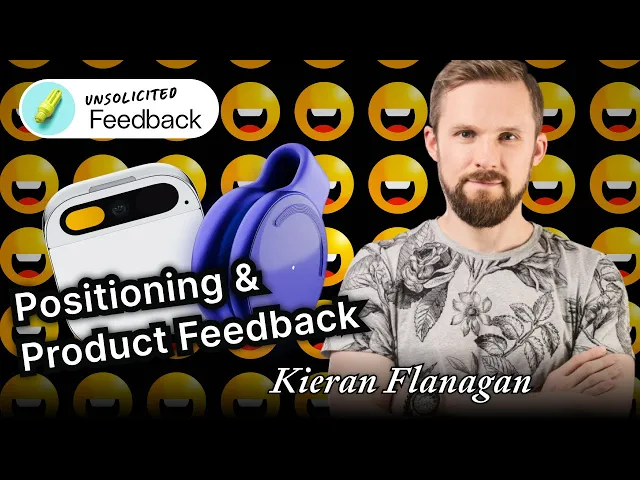
Feedback on Humane, Limitless, and AirChat: Positioning and Strategy Insights w/ Kieran Flanagan
Hosts:
Brian Balfour & Fareed Mosavat
Topics:
Product Strategy, Positioning, Humane, Limitless, and Airchat
Listen on
Spotify | Apple | Pandora | Amazon Music | TuneIn
Feedback on Humane, Limitless, and AirChat: Positioning and Strategy Insights
Feedback on Humane, Limitless, and AirChat: Positioning and Strategy Insights For Early Stage Companies
In Part 2 of our conversation with Kieran Flanagan, CMO behind Zapier & HubSpot, we wanted to get back to our roots with some Unsolicited Feedback on the product launches of Humane AI, Limitless, and AirChat. Along the way, we uncovered a few key lessons for any early stage company navigating the complexities of market entry and product development.
If you think we’re wrong about any of this, we hope you’ll tell us on LinkedIn!
📌 Humane AI Pin: A Cautionary Tale of Over-Promise and Under-Delivery
The Humane AI pin, despite its ambitious launch, faced critical backlash, notably from a popular device reviewer on YouTube, MKHBD, who did not shy away from highlighting its shortcomings. The pin, positioned as a “new computer,” a multi-functional device for various tasks like making calls, sending messages, and managing digital activities. However, its attempt to serve all ended up serving none effectively, revealing a fundamental flaw in both product positioning and expectations management.
Brian emphasized that Humane AI's failure lies in how it was marketed and the unrealistic expectations it set. Had it been called an MVP or a Beta at a lower price point, people would have wildly different expectations, be far less upset by its shortcomings, and be more likely to give its next iterations a chance.
The pin was criticized for its slow responses and inaccuracies, starkly contrasting with the seamless functionality promised.
🚀 Limitless Device: Narrow Focus with Promising Reception
On the flip side, the Limitless device has received a significantly more positive pre-launch reaction, possibly benefiting from its simpler, more focused use case of recording meetings. The device's clear, narrow utility and alignment with its marketing have potentially set it up for better initial success compared to the Humane AI pin.
🏆 Lesson 1: Set Clear Expectations In Positioning
One critical lesson from both the Humane AI and Limitless launches is the importance of setting clear, realistic expectations.
Humane AI’s broad functionality promise and subsequent failure to meet expectations showcased the pitfalls of overpromising.
In contrast, Limitless's focused approach and clear communication about its capabilities set a more achievable benchmark, which has been key to its more positive reception.
🏆 Lesson 2: Be Great at Something
Another key takeaway is the importance of excellence in a specific area rather than mediocrity in many. Humane AI’s attempt to tackle multiple functionalities led to none functioning particularly well. It promised to do 12+ tasks and performed subpar at almost all of them. Had their product strategy been to focus on one task and nail it, they would be much better off today.
This is a stark contrast to Apple’s approach. Fareed discussed Apple's incremental approach, where each iPhone iteration focused on perfecting a few key features at a time. The first iPhone only really nailed calling and Safari. Then, they slowly added in the touch functionality and FaceTime, which they built upon with later additions like Apple Pay. This methodical enhancement over time has allowed Apple to not only perfect each feature but also to build a seamless ecosystem that customers trust and rely on. We recognize the irony here, given the founders of Humane came from product at Apple.
🎙️ AirChat: All-In On Audio-First. Do They See Something We Don’t?
AirChat, a new entrant in the social networking realm, is betting big on the shift towards audio-first communication. Fareed’s been using it and so far, doesn’t really get it. He mainly reads transcripts of audio messages, primarily from the founders, Naval Ravikant, and Brian Norgard.
We suspect the insight was inspired by the younger generation’s preference for voice memos over text. However, the transition from private voice messages to public audio content may not be seamless. Kieran pointed out that texting, a private communication method, doesn’t directly translate to the broadcasting nature of social media. This raises questions about whether AirChat's foundational assumption might be its Achilles' heel.
Additionally, while audio content fills an important niche—providing entertainment when visual engagement isn’t possible—AirChat requires users to remain screen-bound without visual stimuli, which could limit its appeal.
But, who knows? Perhaps we’ll be proven wrong here! Do you think AirChat is a winner?