All episodes
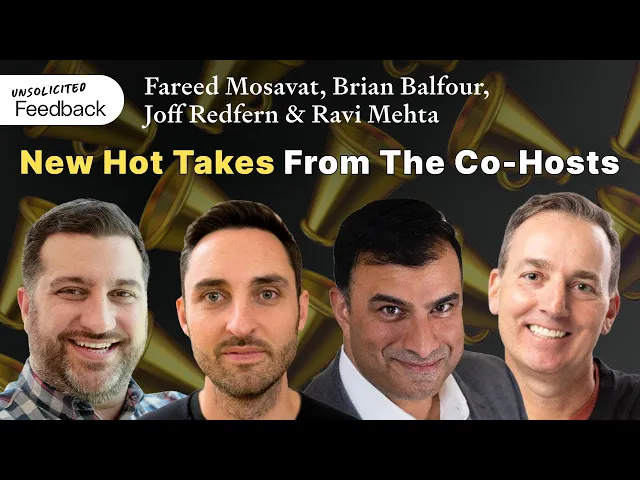
The Future of AI in Marketing, Growth & Content: Season 2 Finale (Part 2) w/ Brian Balfour, Ravi Mehta, Joff Redfern, and Fareed Mosavat
Hosts:
Fareed Mosavat, Brian Balfour, Joff Redfern, Ravi Mehta
Topics:
Decreasing Search Engine Clicks, Trust Shift, Paid Channel Pressures, Content Licensing, Commoditizing AI Models
Listen on
Spotify | Apple | Pandora | Amazon Music | TuneIn
The Future of AI in Marketing, Growth & Content: Season 2 Finale (Part 2) w/ Brian Balfour, Ravi Mehta, Joff Redfern, and Fareed Mosavat
In part two of the Unsolicited Feedback Season 2 Finale, Brian Balfour, Joff Redfern, Ravi Mehta, and Fareed Mosavat return to discuss the challenges associated with marketing in the face of declining search trends. They also explore the growing significance of content licensing deals and contemplate the future as AI models become commoditized and our interactions with them (and expectations of them) evolve.
We teed up the conversation by referencing something we’ve talked about with both Kipp Bodnar and Kieran Flanagan before: the AI Marketing Playbook. A lot of this focused on one main question: As AI-generated answers replace link browsing in search, what strategies can marketers adopt to compensate for the decrease in SEO traffic?
📉 Clicks from Search Engines will Continue to Decrease 📉
The trend of featuring AI answers or summaries as the top search results has begun and is likely to continue. This could lead to fewer clicks on external websites from the search platform.
“I think for the past couple of years, [SEO as a channel] has been in the saturation mode, but I think now it's firmly in the decline mode, decline phase of the S curve. And a lot of that was of course some of the stuff that we've already seen from AI overviews and Google, I think the latest research, even with their small rollout has already reduced clicks to sites by 10%. You got to imagine that's going to increase.” - Brian Balfour
So what’s happening as this trend becomes more clear?
Established companies are shifting their focus from seeing content marketing as a growth driver to maintaining and extracting the remaining value from their existing content while exploring new strategies. For example, you can see how HubSpot has methodically built out a media network that does not depend on search. For new startups, the traditional content marketing playbook is no longer viable for achieving the necessary growth, making it crucial to innovate and find alternative marketing approaches.
👤 People’s Trust Has Shifted to… People 👤
There's a growing distrust in company-generated content, with audiences favoring individual creators. This shift is exemplified by the rise of platforms like Substack. The decline is exacerbated by the oversaturation of content with how easy it has become to produce it with AI, which reduces its overall value and effectiveness.
This shift towards the human creator + the decline in traffic from sources like Google could spur more companies to lean into creators, and/or creators to opt for content distribution methods that don’t rely on search, like social media, podcasts, and more.
Fareed adds, “If Google and other tools just scrape all that stuff and give me the answers and don't trade me any traffic, we're going to see a shift towards more closed gardens.
More things are going to look like Instagram or Facebook or closed social networks where there is no public access and they are not searchable.”
🤑 The pressure on paid channels will increase 🤑
As organic traffic decreases, companies will likely feel pressure to increase their paid spending to make up for that difference in the short term.
Ravi experienced this at TripAdvisor,
“Travel was one of the first areas where Google started to really actively participate by showing airfare prices and hotel prices and essentially having the transactions start to happen on the search results page rather than on the partners that they had worked with in the past, like TripAdvisor and others.
And that led to a shift from organic traffic to paid traffic. And now I think there's a pretty significant amount of downward pressure on, on paid traffic.”
Our hosts hypothesize that new advertising modalities will pop up, especially in audio, as people increasingly use voice interactions, suggesting future business model innovations around non-invasive sponsorship and ad units.
💳 What’s the “deal” with content licensing? 💳
There is an emerging trend of content licensing deals, highlighting that traditional monetization through traffic aggregation is no longer viable. Instead, large foundational models, like those from Reddit and news organizations, are turning to content licensing.
Joff elaborates, “I think that's part of some of the issues that the foundational models are going to be running into, which is ‘hey, we slurped up all the data that's available to us. Now we either need to create synthetic data or we need to go to proprietary collections of data’ Reddit being an obvious one Bloomberg being an obvious one, but I don't know if they would actually license their data store.”
Our hosts question if this will develop into a broader marketplace or remain limited to major traffic aggregators. They emphasize the complexity of copyright law, lawsuits against companies like OpenAI and Microsoft, and the need for proprietary data for AI models as complications.
💬 Will our experience with AI change as the models are commoditized? 💬
Our main interaction with these new AI models, so far, has been through chat or copilot interfaces. Is that a temporary and juvenile phase? Or is that here to stay?
Fareed thinks it’s temporary. “I think that we will look back at this time as the weird little funny chatbot phase that was a transitionary period between the evolution of the creation of the foundational models.”
They go on, observing how AI will increasingly streamline complex processes into simpler, more efficient workflows, and that it’s the better use of the technology versus chatbots / copilots.
Ravi says, “I think the problem with chat based interfaces is they're very high friction. They require you to pull the answer from the system rather than push the answer to you, I think one of the best examples of AI fundamentally innovating around user interfaces is Descript versus Final Cut Pro or other video editors.
They were able to use AI and say, we can create a fundamentally different interface for editing videos. So rather than editing video on a timeline, you're going to edit video on a script because of the transcription capabilities of AI. And that I think is going to be an example of the types of user interface innovations that we start to see.”
Do you have thoughts on these topics? We’d love to hear about it on LinkedIn!