All episodes
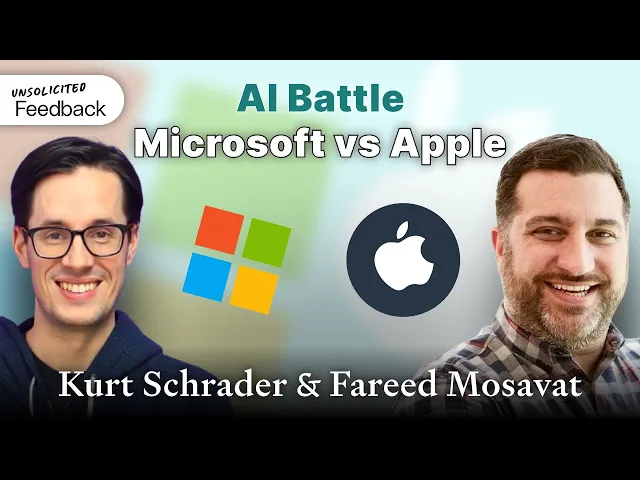
Microsoft’s Game-Changing Releases: Is Windows Poised to Dominate the AI Era? w/ Kurt Schrader
Hosts:
Fareed Mosavat
Topics:
Microsoft, Windows, Copilot, Apple, AI, Product Strategy
Listen on
Spotify | Apple | Pandora | Amazon Music | TuneIn
Microsoft’s Game-Changing Releases: Is Windows Poised to Dominate the AI Era? w/ Kurt Schrader
Microsoft’s Game-Changing Releases: Is Windows Poised to Dominate the AI Era? w/ Kurt Schrader
In this episode of 'Unsolicited Feedback,' host Fareed Mosavat and guest Kurt Schrader, CEO and founder of Shortcut, dive into Microsoft's latest AI announcements, including the Copilot+ PC initiative and Windows Recall. We explore the potential impact of these innovations on the consumer market and reflect on how Apple should respond at the upcoming WWDC. We also debate the strategic strengths and weaknesses of both tech giants in the evolving AI landscape.
Before we dive in, Fareed mentioned in the podcast that Reforge has just launched a brand new AI product, the Reforge Extension, now in public beta. Ever wish you could get expert feedback from leaders like Fareed, Brian Balfour, Andrew Chen, and Elena Verna while working on your documents? Now you can!
Install it for free today and elevate your work with Reforge experts by your side.
Join us for refAI, a full-day virtual conference delving into all things AI, featuring a special episode of Unsolicited Feedback with the legendary Andrew Chen. Secure your spot now as spaces are limited. Register here today.
📈 Setting New Standards with Copilot+ PCs
Microsoft's latest announcements reveal a bold new direction in AI integration, focusing on the Copilot+ PC program. This initiative sets specific hardware requirements, such as 16 GB of RAM and the ability to perform 40 trillion operations per second, ensuring a consistent and powerful AI experience across devices. This marks a significant shift towards a full-stack, integrated approach, and away from their typical approach of enabling their hardware and software to be used interchangeably with competitor products.
🔍 Windows Recall: Enhancing Productivity Through Memory
One of the most groundbreaking features is Windows Recall, which continuously captures snapshots of your screen and activity. This allows users to revisit their workflow, aiding in productivity and problem-solving. However, it also raises privacy concerns, which Microsoft is addressing by ensuring data stays local and implementing features to exclude sensitive content.
🤝 Bridging the Gap Between Consumer and Enterprise Markets
Microsoft's new strategy blurs the lines between consumer and enterprise markets. Historically viewed as an enterprise-centric company, this move suggests a return to consumer-focused innovation, aiming to rival Apple's dominance. The integration of AI at the OS level promises enhanced user experiences, from creating complex Excel functions to seamless transitions across applications. By creating a tightly integrated hardware and software ecosystem, reminiscent of Apple's approach, Microsoft aims to recapture the high-end consumer mindshare.
🛠️ Developer-Centric Innovations
Microsoft's developer-friendly approach remains a core strength. By providing robust APIs and encouraging third-party integrations, they empower developers to harness the full potential of AI within their applications. This openness contrasts with Apple's more closed ecosystem, potentially offering Microsoft a competitive edge in fostering innovation and expanding AI capabilities.
📱 The Apple Dilemma: Adapt or Fall Behind?
Apple's annual release cycle and focus on a narrow set of polished features face a formidable challenge. As Microsoft pushes rapid, continuous updates, Apple's slower, more deliberate approach may need reevaluation. We are eagerly awaiting Apple's response, especially with rumors of potential partnerships with AI leaders like OpenAI, but at this point, aren’t optimistic. It feels like we’ll only get a small step at WWDC, not a leap.
🌐 Future Outlook: Hardware Matters Again
Microsoft's emphasis on hardware requirements signals a resurgence in the importance of physical devices in an era dominated by cloud-based solutions. As AI capabilities increasingly rely on local processing power, the trust and security provided by owning the hardware and software stack become paramount.
As AI becomes more embedded in our daily tools, the way we interact with technology is set to transform. The convenience and power offered by integrated AI assistants will likely become a standard expectation, pushing all tech companies to elevate their game. The question is, who has the right vehicle for it?
👂 The Only Hope: AirPods
While we’re suddenly really excited by Windows and Microsoft (and shocked we’re typing that…), we still believe that the future of AI hardware is not a computer. The saving grace for Apple? AirPods! We’re pretty convinced that Apple should lean in on this undervalued product, and give AirPods the power of AI. We can’t imagine we’re going to hear anything soon about this, but we can keep our fingers crossed.
🌐 vs 🔎 The Battle of AI Assistants: Microsoft vs. Apple
A core question we grappled with is whether the majority of tasks people want from their AI copilot assistants—whatever we call them—fall into a predictable set or if they span a long tail of unpredictable needs. Historically, Apple has focused on a smaller subset of high-functionality tasks that cover most needs, as seen in their approach with products like Apple Photos and Numbers. Microsoft, however, tends to offer far more robust offerings that can truly handle all of the edge cases. Which one will be more important in the long run? Maybe both?
How do you see the future of AI-integrated hardware unfolding? Will privacy concerns shape the development and adoption of these technologies? Join us on LinkedIn to discuss further!