All episodes
Box CTO's Approach to Enterprise AI Tools & Insights from Google and OpenAI's Latest Releases w/ Ben Kus
Hosts:
Fareed Mosavat
Topics:
Box, AI, Google, OpenAI, Enterprise SaaS
Listen on
Spotify | Apple | Pandora | Amazon Music | TuneIn
Box CTO's Approach to Enterprise AI Tools & Insights from Google and OpenAI's Latest Releases w/ Ben Kus
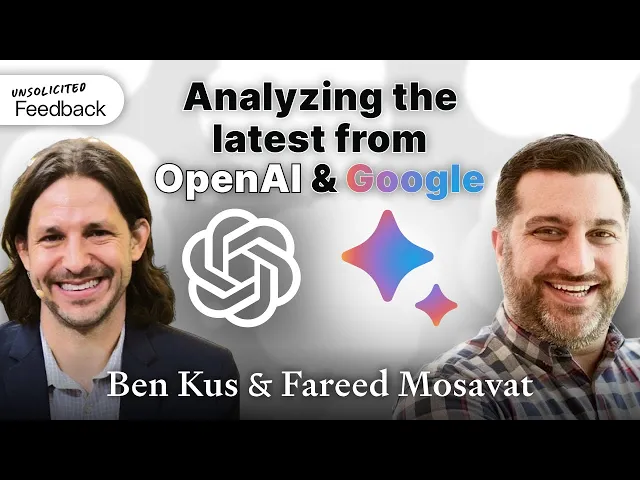
In the latest episode of "Unsolicited Feedback," Fareed Mosavat chats with Ben Kus, CTO of Box, to delve into the dynamic world of AI advancements and their implications for technology companies and users alike. This episode offers rich insights into how multimodal AI is transforming the tech landscape, driven by recent announcements from OpenAI and Google.
We're back this Thursday, and it's time to get technical! In Part 2 of our discussion with Ben, he'll share his methods for evaluating foundational models and transforming unstructured data into structured data.
Harness Multimodal AI for Diverse Applications 🌐
The shift towards multimodal AI is here, where models like GPT-4v and GPT-4o go beyond text to integrate visuals and omnichannel capabilities. Ben emphasizes the significance of these advancements, noting how they enable AI to perceive and respond in ways similar to human interactions. This evolution is not just about making AI better, faster, and cheaper but also about broadening its applications across various mediums. Embracing multimodal AI is destined to provide a richer, more intuitive experience.
Real-Time Demos Build Trust in AI Capabilities 📺
We miss the charm of llive demos, particularly OpenAI's approach of showcasing real-time applications. Despite minor hiccups, these demos foster trust and authenticity, proving that the technology is genuinely functional and not just a polished presentation. If your product works well, consider going live. This is particularly important in AI where customers are highly skeptical of companies overpromising and under-delivering. GPT-4o’s unveiling was perfect in our book.
Google vs. OpenAI: Divergent Approaches to AI Integration 🏢⚡🤝
A key theme of the discussion is the contrasting strategies of Google and OpenAI in integrating AI into their offerings. Google aims to enhance its existing products with AI, making tools like search, email, and maps more powerful and efficient. This approach leverages familiar use cases, subtly embedding AI to improve everyday tasks.
In contrast, OpenAI is focused on introducing new use cases for AI, encouraging users to explore and adopt entirely new ways of interacting with technology. Their strategy involves live demos to showcase the real-time capabilities of their models, creating an authentic and engaging experience.
Both are completely valid, but it’s important to know which approach aligns with your goals. The reality is, most of us are working on projects similar to Google's model of integrating AI into familiar tools. But, if you are pioneering new applications, OpenAI's approach of using live demos to demonstrate the novel use cases is likely more suitable.
AI is Just a Tool 🛠️🔍
Google's strategy of embedding AI into existing products illustrates a seamless approach to enhancing user experiences. Ben notes that this integration makes AI a tool to improve daily tasks rather than a standalone feature, aligning with Box's philosophy of using AI to augment enterprise content management.
When mobile first emerged, and when cloud computing first appeared, everyone talked about releasing a mobile app or a cloud offering. Now we just talk about the product, and it’s assumed that mobile apps or cloud storage will be part of the execution, if relevant. Unless you’re building foundational models, it’s important to start thinking of AI this way too—integrating it into tools and workflows to enhance their functionality, making it an unobtrusive yet powerful addition to users' daily routines.
Consider Building an Internal Platform If You're in an Enterprise B2B Company 🏢🔒
For enterprise-focused companies, the challenge lies in balancing rapid innovation with the stability and security demands of their customers. Ben shares Box's approach of developing an internal AI platform that abstracts the complexities, allowing product teams to innovate without compromising on compliance and control.
At Box, Ben built a robust internal platform adhering to all safety and security practices. This platform ensures compliance with enterprise-grade requirements, addressing concerns around data privacy and regulatory obligations. Once the platform was validated and approved by enterprise clients, Ben gave his teams free rein to use it for various applications.
If you’re in a similar environment, building a platform might be the right strategy for you too. It allows you to develop a secure and compliant internal AI platform while empowering your teams to innovate confidently and rapidly.
Looking Ahead: The Future of AI in Enterprises 🚀🏢
Ben envisions a future where AI seamlessly integrates into enterprise environments, transforming how organizations manage and interact with their content. He encourages companies to experiment with AI capabilities, recognizing that today's innovations will shape tomorrow's standard practices.
How are you planning to integrate the latest AI advancements into your products and services to enhance user experiences and stay competitive in a rapidly evolving landscape?