All episodes
Casey Winter's Take on HubSpot's Product Announcements, the Creator Economy & the Future of Marketplaces
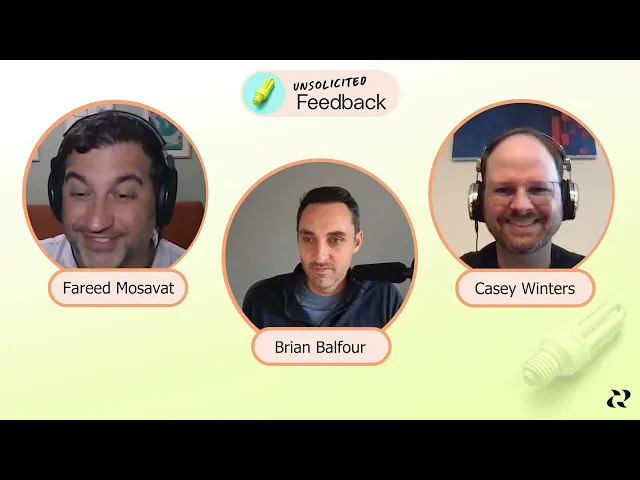
Hosts:
Brian Balfour & Fareed Mosavat
Topics:
HubSpot’s Unsung Hero, Creator Economy/Marketplaces
Listen on
Spotify | Apple | Pandora | Amazon Music | TuneIn
HubSpot’s latest release
HubSpot's annual inbound conference serves as a platform for announcing new product releases, with a particular focus on AI-driven solutions.
However, Brian argues that the true standout is not the anticipated AI-driven solutions, but rather a hidden gem that seems to be overshadowed - the Commerce Hub. 👀
🛒 The Commerce Hub is HubSpot's latest product offering, which aims to integrate payments, billing, and subscriptions into their ecosystem.
💡 Expanding product market fit can be achieved through three strategies: moving current offerings to adjacent markets, expanding the current market with new products, and diversification into new products and markets. HubSpot has successfully implemented the first strategy by expanding their product offerings within their current market, leveraging their existing customer base. 📈
The experts believe that the Commerce Hub could be a game-changer for HubSpot for several reasons:
💰 It presents an opportunity for HubSpot to replicate the success of companies like Shopify, which generate a significant portion of their revenue from transaction fees and merchant solutions.
💼 HubSpot's SMB focus makes them uniquely equipped to release this offering. Unlike Salesforce's enterprise clients, SMB customers prefer simplicity and having everything under one roof.
🔝 HubSpot's focus on cross-selling and expanding their product suite within their mid-market customer base has been a key driver of their growth, following a successful B2B product expansion playbook.
But, Casey shares a reservation that betting against Shopify is a dangerous game. Only time will tell. 🤔⏳
Viability of the Creator Economy
Hunter Walk's recent article "The only thing which has failed about the creator economy thus far as venture capitalists attempt to get their piece, why there's never been a better time to be a creator," struck a chord with Fareed.
💰 In the article, Walk states that it has never been easier for creators to make $50,000 per year doing what they love.
Casey highlights a few key caveats:
🎯 Different segments of creators have different needs, so a one-size-fits-all approach doesn't work
📦 Fulfillment alone is not enough to help creators monetize effectively, or is a venture back-able business
📈 Creators need assistance in driving demand, which many creator economy companies fail to provide
Brian points out the tension between creators' desire for demand and their desire to own their own audience. 🤝
📉 High take rates can lead to creators leaving once they become more successful
Fareed suggests that there are two types of companies in the creator economy: low-margin businesses that prioritize efficiency and high-margin businesses that focus on craftsmanship.
⚖️ Most creator economy startups are low-margin plays, but can you imagine a high-margin creator economy play?
📰🎵 Fareed imagines a company that could take 50% of the revenue and can do so because they add significant value. The closest comparison would probably be a record label or a newspaper, as they deliver demand to musicians and writers who just want to do their craft.
💡 When selecting creators to target, it would be best to choose those who have no interest in marketing because demand-driving companies can have the biggest impact here.
🎨💼 Creators want to create, and unfortunately, the most successful creators end up being those who are best at marketing rather than those who are best at their craft.
Future of Marketplace Businesses
We wrap up this episode by getting Casey's bullish perspective on the future of marketplaces:
📲🔄 Good businesses require platform shifts to enable growth opportunities. We haven't had one since the mobile phone era, and we are overdue for a new one.
🏠🍽️ Airbnb and DoorDash may have reached a size where they can serve as platforms for venture-scale businesses.
🧩 All we need are the right ingredients: clear fragmentation of supply and a high frequency of need on the demand side.